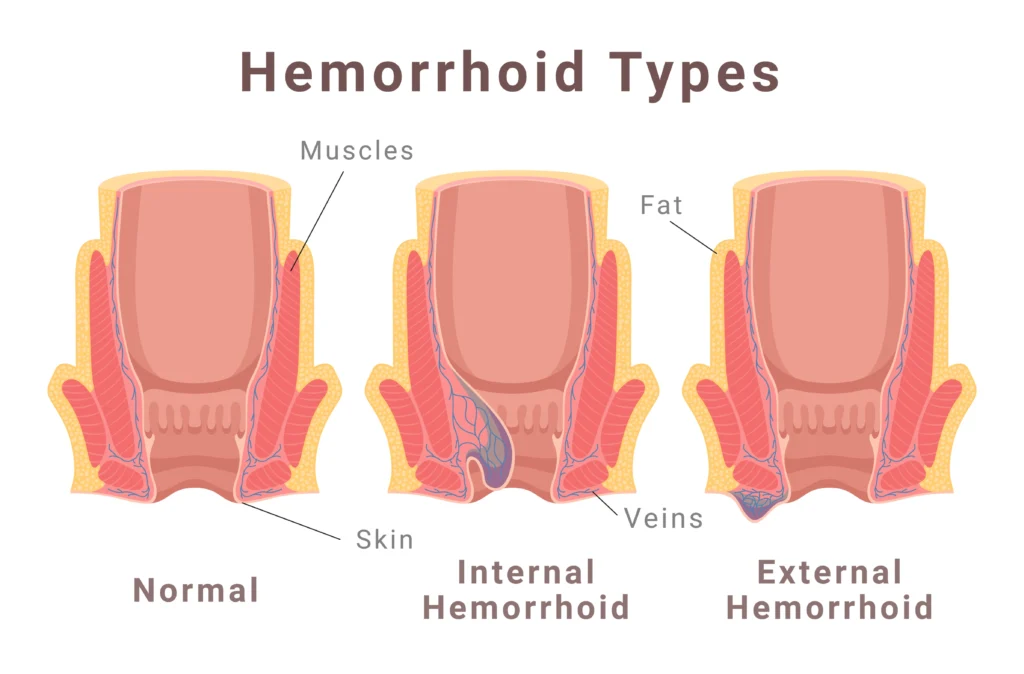
Internal hemorrhoidal disease occurs when the veins inside the rectum, known as internal hemorrhoids, become swollen, enlarged, and symptomatic. Internal hemorrhoids are normally present in everyone and help with stool control, but when they receive too much blood flow or increased pressure, they begin to bulge, bleed, and cause discomfort.
Internal hemorrhoidal disease develops when these veins can no longer return blood efficiently, leading to:
This condition is often graded based on severity:
Internal hemorrhoidal disease is common and can be triggered by chronic constipation, straining, pregnancy, obesity, prolonged sitting, or weakened supporting tissue with age.
When symptoms persist despite conservative treatments such as fiber, hydration, or topical medications, minimally invasive procedures like Hemorrhoid Artery Embolization (HAE) can offer effective, long-lasting relief.
Internal hemorrhoids often cause symptoms inside the rectum and may not always be painful. Common signs include:
Symptoms tend to worsen with straining, constipation, or prolonged sitting.
Internal hemorrhoids become symptomatic when blood flow or pressure increases in the hemorrhoidal veins. Common causes include:
These factors lead to swelling, enlargement, and prolapse of the internal hemorrhoidal tissue.
Internal hemorrhoidal disease is not just a digestive issue, it is fundamentally a vascular condition. Internal hemorrhoids are clusters of blood vessels inside the rectum that normally help with stool control. When the arteries supplying these vessels deliver too much blood flow, or when veins cannot drain blood properly, the hemorrhoidal tissue becomes swollen, enlarged, and symptomatic.
This abnormal blood flow leads to:
Because the problem originates in the hemorrhoidal arteries and veins, internal hemorrhoids respond especially well to treatments that address the vascular cause—not just the symptoms.
One of the most effective options is Hemorrhoid Artery Embolization (HAE), which gently blocks the excessive blood flow feeding the hemorrhoids. By reducing arterial pressure, the hemorrhoids shrink, symptoms improve, and bleeding often stops completely—all without surgical cutting or removal.
Understanding internal hemorrhoids as a vascular condition helps explain why lifestyle changes and topical creams may provide only temporary relief, while targeted vascular treatment leads to longer-lasting improvement.
Book your appointment with Heart Vascular & Leg Center
today for personalized care and advanced treatment.
At Heart, Vascular & Leg Center, we offer both conservative and advanced minimally invasive treatments, depending on severity:
Conservative Options
Advanced Treatment: Hemorrhoid Artery Embolization (HAE)
A minimally invasive procedure that reduces blood flow to the hemorrhoidal tissue, leading to:
HAE is performed through a small catheter, requires no incisions, and has faster recovery compared to surgical hemorrhoidectomy.
Advanced, minimally invasive procedures
Outpatient care
Faster recovery
Expert, patient-focused treatment
Supportive and comfortable environment
Book your appointment with Heart Vascular & Leg Center
today for personalized care and advanced treatment.




5020 Commerce Drive
Bakersfield, CA 93309
If you’re experiencing symptoms of vascular disease or are at risk for conditions like PAD, don’t wait to seek care. Schedule an appointment with Heart Vascular and Leg Center today. Our specialists will assess your condition and guide you toward the most effective treatment options—whether it’s lifestyle modifications, medication, or advanced minimally invasive procedures. Your vascular health is our priority, and we’re here to help you regain comfort, mobility, and confidence. To learn more about our expert care in Bakersfield, CA, or to get started with our team, reach out today.
Hear from our patients about their experiences at Heart Vascular and Leg Center.





Stay informed with trusted insights on vascular health, PAD prevention, and advanced treatments.
Book your appointment with Heart Vascular & Leg Center
today for personalized care and advanced treatment.

Also visit: