

Knee Pain at Night: Why It Gets Worse When You Stop Moving and What It Could Mean
 |
Most people expect joint pain to get worse during activity. Push it too hard, feel it afterward. That logic makes sense.
So when knee pain is worst at night, when you are lying still, not putting any weight on it, not doing anything at all, it catches people off guard. Some assume they slept in a bad position. Others take a painkiller and try to push through.
What fewer people know is that nighttime knee pain has a specific meaning. It is not random. It is telling you something about what is driving the pain, and it points directly toward a mechanism that standard treatments often miss.
Why Rest Does Not Always Bring Relief
There are two broad categories of knee pain. Mechanical pain and inflammatory pain.
Mechanical pain is load-driven. It gets worse when you put weight on the joint, walk, or climb stairs. It tends to ease when you sit down or lie still. This is the pattern most people with knee arthritis expect.
Inflammatory pain works differently. It is driven not by how much load the joint is carrying, but by active inflammation inside the joint. Research from the journal Arthritis and Rheumatology has shown that inflammatory activity in arthritic joints follows a circadian pattern, often peaking in the evening and overnight ↗. When inflammation is high, lying down does not bring relief because removing the load from the joint does not stop the inflammatory process that is generating the pain.
This is why nighttime knee pain, pain that is present or worse at rest, is one of the clearest signals that inflammation is the dominant driver. And why treatments that focus only on the structural side of the knee often fail to address it.
Read Also: The Real Reason Your Knee Pain Keeps Coming Back. And What Actually Helps
The Vascular Side of Nighttime Inflammation
 |
Inside an arthritic knee, abnormal blood vessels grow into the soft lining of the joint, a layer called the synovium. These vessels should not be there. Once they form, they continuously deliver inflammatory signals into the joint. They do not switch off when you go to bed. They do not reduce their activity because you stopped walking.
This vascular inflammation is one of the primary reasons why nighttime and resting pain is so persistent in arthritis patients. Studies on synovial neovascularization in osteoarthritic joints have identified abnormal blood vessel proliferation as a key driver of chronic joint pain independent of cartilage damage ↗. The structural damage stops at a certain point. The vascular activity does not.
This is also why standard treatments often fall short specifically for nighttime pain. Cortisone reduces inflammation temporarily but does not remove the abnormal vessels generating it. Physical therapy strengthens the muscles around the joint but cannot reach the vascular activity inside the joint lining. Anti-inflammatory medications suppress the signal but do not address the source driving chronic knee pain.
Read Also: You Have Been Managing Your Knee Pain. But Are You Actually Getting Better?
What Genicular Artery Embolization Does for Inflammatory Knee Pain
Genicular Artery Embolization targets the abnormal blood vessels responsible for the inflammatory activity in the joint. By reducing blood flow to those specific vessels, it calms the inflammatory cycle at its source rather than suppressing the pain response temporarily.
For patients whose pain is predominantly inflammatory, including those with significant nighttime and resting pain, this approach addresses what most other treatments do not reach. It is a minimally invasive, outpatient procedure with no hospital stay and no general anesthesia. Patients go home the same day. Relief typically begins within a few days and continues to develop over the following weeks as the inflammation in the joint gradually settles.
It does not rebuild cartilage and is not appropriate for every patient. But for patients with significant inflammatory knee pain that has not responded to conservative treatment, it is a conversation worth having before moving to knee replacement surgery.
When to Take Nighttime Knee Pain Seriously
Occasional discomfort at night after a particularly active day is not unusual. What warrants attention is a consistent pattern:
- Knee pain that wakes you up or makes it difficult to fall asleep regularly
- Pain that is present at rest or first thing in the morning before you have put any load on the joint
- Significant joint stiffness in the morning that takes more than 30 minutes to ease, which the American College of Rheumatology identifies as a hallmark of inflammatory joint disease ↗ rather than purely mechanical wear
- Nighttime pain that is not responding to over-the-counter anti-inflammatory medications
- Any of the above alongside chronic hip pain or chronic shoulder pain, where similar inflammatory vascular activity can occur
 |
Available in Bakersfield
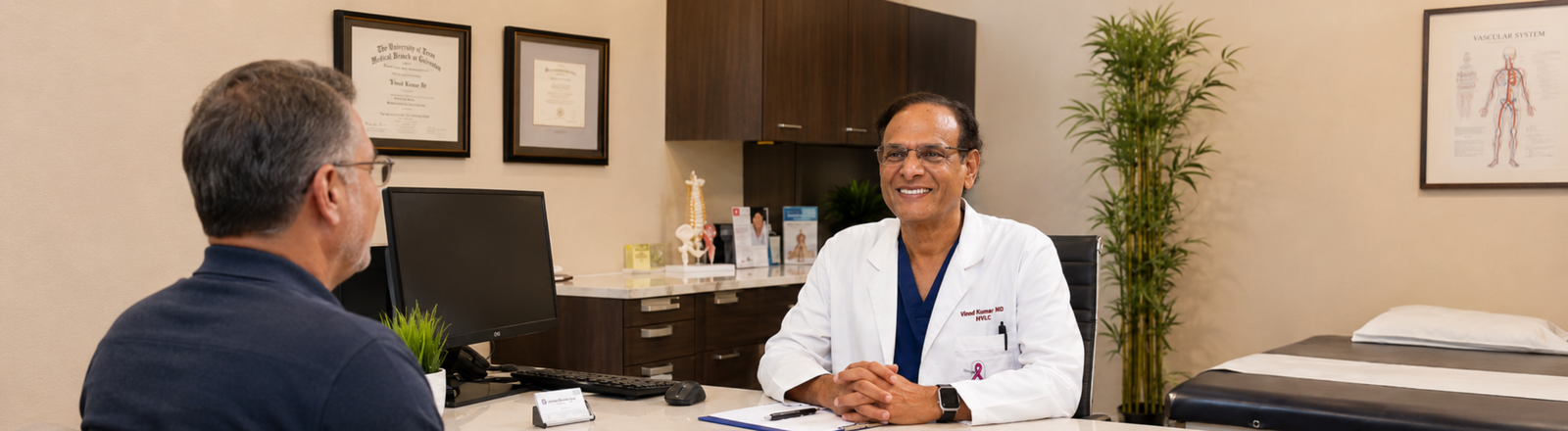
Dr. Vinod Kumar and the team at Heart Vascular and Leg Center offer Genicular Artery Embolization as a minimally invasive option for patients with chronic inflammatory knee pain, including those whose pain is worst at night or at rest.
If you have been waking up with knee pain and nothing has fully addressed it, the vascular component of your inflammation may not have been evaluated. That is worth finding out. Meet the full team here.
Frequently Asked Questions
Why does knee pain get worse at night?
Nighttime knee pain is usually a sign of inflammatory rather than mechanical pain. Inflammatory activity inside the joint follows a circadian pattern and often peaks in the evening and overnight. Unlike mechanical pain which eases when you remove load from the joint, inflammatory pain is driven by abnormal blood vessel activity in the joint lining, which continues regardless of whether you are resting or moving.
What does it mean when knee pain is worse at rest?
Pain that is worse at rest or at night typically indicates active inflammation in the joint rather than purely structural damage. This pattern suggests that the synovial lining of the joint is inflamed and that the pain is being generated by an ongoing vascular inflammatory process, not just by the mechanical stress of weight-bearing.
Can Genicular Artery Embolization help with nighttime knee pain?
Yes, particularly for patients whose nighttime pain is driven by vascular inflammation in the joint lining. Genicular Artery Embolization reduces blood flow to the abnormal vessels responsible for joint inflammation, addressing the source of the pain rather than suppressing the symptom temporarily. It is an outpatient procedure with no hospital stay. Whether it is appropriate depends on the individual patient, and a consultation is the best way to find out.
How is inflammatory knee pain different from mechanical knee pain?
Mechanical knee pain is driven by load and structural damage. It tends to worsen with activity and ease with rest. Inflammatory knee pain is driven by active inflammation inside the joint and often persists or worsens at rest, particularly at night. Many patients with osteoarthritis have both components, but the inflammatory element is frequently undertreated because standard approaches focus primarily on the structural side.
Where can I get treatment for nighttime knee pain in Bakersfield?
Heart Vascular and Leg Center, located at 5020 Commerce Drive, Bakersfield, CA, offers Genicular Artery Embolization for chronic inflammatory knee pain. Dr. Vinod Kumar, MD, FACC, leads the specialist team. Call 661-324-4100 or visit heartandleg.com to book a consultation.








Follow us on: