
Non-Surgical Knee Pain Relief: What GAE Offers When Everything Else Has Failed
The Problem With “Try Everything First”
You have done everything right.
Physical therapy. Anti-inflammatories. Cortisone injections. Maybe a PRP injection. Possibly a second opinion, or a third. And your knee still hurts – every morning, every flight of stairs, every walk across a parking lot.
This is not a failure of effort. It is a failure of the treatment target.
For a significant number of patients with chronic knee pain, the pain is being sustained by something that none of those treatments address: abnormal blood vessel growth inside the knee joint. Until that is identified and treated, the pain cycle continues regardless of what else you try.
Genicular Artery Embolization – GAE – is a minimally invasive procedure that targets exactly that mechanism. It is not a last resort. It is the right first step once the vascular component of your pain has been confirmed.
Why Chronic Knee Pain Is Different From Acute Knee Pain
Acute knee pain – a sprain, a post-surgical flare, a sudden injury – involves genuine inflammation. The tissue is acutely injured. Inflammatory mediators flood the joint. Anti-inflammatories and cortisone are exactly the right tool for that phase.
Chronic knee pain is different. After roughly three months, the tissue undergoes a change. The acute inflammatory picture gives way to a degenerative process driven by a different mechanism: neovascularization – the growth of new, abnormal blood vessels into the synovial tissue and periarticular structures of the knee.
These vessels bring sensory nerve fibers with them. The result is a direct pain signal that persists independently of inflammation. Cortisone cannot suppress it because there is nothing inflammatory to suppress. Physical therapy cannot eliminate it because the vessels are not responsive to mechanical loading. The pain signal has a structural vascular source – and that is what GAE is designed to reach.
What Diabetes Has to Do With Your Knees
November 14 is World Diabetes Day – and the connection between diabetes and chronic knee pain is more direct than most patients realize.
Diabetes accelerates joint degeneration through several overlapping mechanisms. Elevated blood glucose promotes advanced glycation end-products (AGEs) that stiffen cartilage and degrade its load-bearing properties. Diabetic microvascular disease impairs the already-limited blood supply to cartilage, accelerating wear. Peripheral neuropathy can reduce proprioceptive feedback, leading to abnormal joint loading over time.
The cumulative result: diabetic patients develop knee osteoarthritis earlier, progress faster, and are significantly more likely to experience the chronic pain cycle that conservative treatment cannot break.
There is also a practical problem. Many of the standard pharmacological options for knee pain – prolonged NSAID use, repeated corticosteroid injections – carry elevated risks in diabetic patients. NSAIDs affect renal function, which is already compromised in diabetes. Cortisone injections transiently elevate blood glucose, sometimes significantly, in patients whose glucose control is already difficult.
GAE does not carry either of those risks. It is a vascular procedure – catheter-based, minimally invasive – that addresses the source of pain without the systemic effects of pharmaceutical management.
How GAE Works
Genicular Artery Embolization is performed by an interventional specialist – a physician trained in catheter-based vascular procedures. The process follows a defined sequence:
1. Imaging Confirmation
Before the procedure, imaging – typically power Doppler ultrasound or MRI – confirms neovascular flow in the periarticular tissue of the knee. This rules out structural pathology that would need surgical management (such as a complete meniscal tear requiring repair) and identifies the specific vessel anatomy that will be targeted.
2. Catheter Access
A small catheter is inserted through a pinhole access point, typically in the wrist or groin, under local anesthesia. The patient is awake. The procedure does not require general anesthesia.
3. Selective Embolization
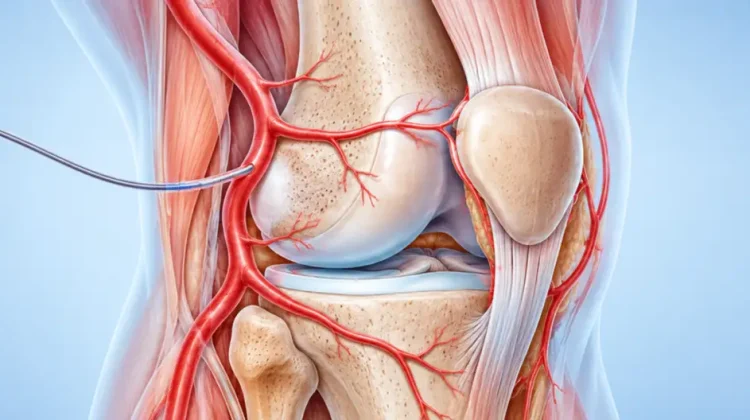
Using real-time X-ray imaging (fluoroscopy), the interventional specialist navigates the catheter to the genicular arteries – the network of small vessels supplying the knee’s synovial tissue. Microspheres are delivered to selectively reduce blood flow to the neovascular tissue while preserving normal arterial supply to the joint.
4. Vessel Regression and Pain Reduction
Over the following weeks, the abnormal vessels regress. The sensory nerve fibers that traveled with them lose their vascular support. Pain signals reduce. Most patients begin noticing improvement within two to six weeks, with peak benefit typically reached by three months.
Who Is a Candidate for GAE?
GAE is appropriate for patients who meet the following profile:
- Chronic knee pain lasting three months or longer
- Diagnosis of knee osteoarthritis (mild to moderate on imaging) or chronic tendinopathy
- Two or more failed conservative treatments – physical therapy, NSAIDs, or corticosteroid injections
- No complete structural tear requiring surgical repair
- Neovascular flow confirmed on imaging
Diabetic patients with chronic knee pain and contraindications to long-term NSAIDs or repeated cortisone are often well-suited candidates. The absence of pharmaceutical systemic effects makes GAE a particularly reasonable option in that population.
GAE is not appropriate for patients with severe osteoarthritis (Kellgren-Lawrence grade 4) with complete joint space loss, active joint infection, or significant structural instability. A pre-procedure evaluation determines candidacy.
What Recovery Looks Like
GAE is an outpatient procedure. Most patients go home the same day and return to light activity within 48 to 72 hours.
The treatment timeline is not immediate – this is not a cortisone injection that produces same-day relief. The mechanism is vascular: the vessels must regress over several weeks before the nerve signal quiets. Patients who go into the procedure with that expectation manage the recovery period well. Those expecting immediate relief find the first few weeks confusing.
Published data shows clinically significant pain reduction and functional improvement at three and six months, with durable results at one year in patients who completed appropriate follow-up.
GAE vs. Knee Replacement: Why the Comparison Matters
The usual conversation about chronic knee pain eventually reaches knee replacement. And for patients with end-stage joint disease and severe structural loss, total knee arthroplasty is the right answer.
But that is not the population that benefits most from GAE. GAE is for the earlier and middle part of the knee pain trajectory – patients who have real, functionally limiting pain but who are not yet at the surgical threshold, or who are not surgical candidates for reasons of age, comorbidity, or preference.
For that population, the surgical conversation is premature. The vascular component has not been addressed. GAE addresses it – and the functional improvement it produces often delays or eliminates the need for eventual surgery.
That is not a claim against surgery. It is a recognition that the treatment ladder has a step that many patients skip entirely because they were never told it existed.
Frequently Asked Questions
Is GAE covered by insurance?
Coverage varies by insurer and plan. Our team will verify your benefits before the procedure and walk you through what to expect. Call us at 661-324-4100 for a benefits check.
How long does the procedure take?
Most GAE procedures take between one and two hours, including pre-procedure preparation. You will typically be home the same day.
Will I need both knees treated?
If both knees have confirmed neovascularization, they can be evaluated together. Whether to treat both in the same session or sequentially is determined during your pre-procedure planning.
How is GAE different from a cortisone injection?
A cortisone injection suppresses inflammation acutely. GAE addresses the abnormal vascular network sustaining the pain signal in chronic knee disease. The mechanisms are different, and the appropriate use cases are different. If cortisone has stopped providing lasting relief, it is a strong indicator that the inflammatory phase has resolved and the vascular component is dominant.
Can I have GAE if I have diabetes?
Diabetes is not a contraindication to GAE. In fact, diabetic patients with chronic knee pain and contraindications to long-term NSAIDs or cortisone are often particularly well-suited candidates. A pre-procedure evaluation will assess your full clinical picture.
Ready to Find Out If GAE Is Right for You?
If you have been living with knee pain for more than three months and conservative treatment has not delivered lasting relief, a vascular evaluation could change the direction of your care.
Heart Vascular and Leg Center – Bakersfield, CA
Phone: 661-324-4100 | heartandleg.com
Appointments available. Referrals welcome.







Follow us on: