
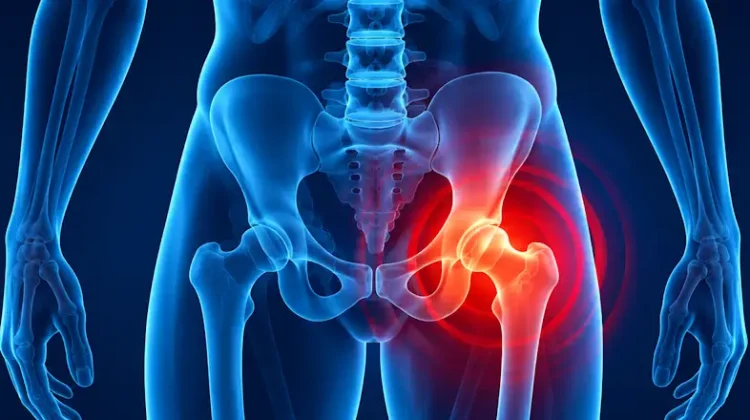

The Gap Between Conservative Care and Surgery
Hip pain has a well-mapped treatment ladder. Rest and anti-inflammatories first. Then physical therapy. Then cortisone injections. Then PRP, possibly. And eventually, if nothing works: total hip replacement.
What that ladder misses is the step in the middle – the one that addresses the reason conservative treatment has stopped working without going all the way to joint replacement surgery.
That step is TAME: Targeted Arterial Micro-Embolization.
It is a catheter-based vascular procedure that targets the abnormal blood vessel network sustaining chronic hip pain in patients who are past the conservative care ceiling but not yet at the surgical threshold – or who are not surgical candidates for other reasons.
Understanding what TAME does, and what it does not do, is the right starting point for any patient with chronic hip pain who has run out of options before surgery.
Read also: Chronic Hip and Joint Pain – Conditions Overview
Why Chronic Hip Pain Is Different From What You Were Initially Told
The first conversation about hip pain almost always focuses on the joint itself – the cartilage, the labrum, the bony anatomy visible on X-ray or MRI. That is the right focus for structural pathology: a labral tear that needs repair, significant bone-on-bone loss that warrants replacement.
But a large proportion of patients with chronic hip pain – particularly those with mild to moderate OA, trochanteric bursitis, or chronic tendinopathy of the hip abductors – do not have structural pathology that explains the severity of their pain. The structural picture looks the same as it did two years ago. The pain has gotten worse.
The explanation is in the vascular biology of chronic pain. In the chronic phase – typically after three to six months of persistent symptoms – the tissue around the hip joint undergoes a change called neovascularization. Abnormal new blood vessels grow into the synovial membrane, the periarticular tendons, and the bursal tissue. These vessels bring sensory nerve fibers with them. The nerve fibers create a direct pain signal that is structurally embedded in the tissue and does not respond to inflammation management – because, by this point, inflammation is no longer the primary driver.
This is why the cortisone injections stopped working. And why more of the same will not change the trajectory.
External resource: Synovial neovascularization in hip osteoarthritis – JVIR research
What Is TAME?
Targeted Arterial Micro-Embolization is a procedure developed within interventional radiology and interventional cardiology for the treatment of chronic musculoskeletal pain caused by neovascularization. It uses a catheter – a thin, flexible tube – to deliver microspheres directly to the abnormal vessels supplying the painful tissue, selectively reducing blood flow to the neovascular network while leaving the normal vascular supply to the joint intact.
The word “targeted” is deliberate. TAME is not a generalized procedure. Pre-procedure imaging – power Doppler ultrasound, and in some cases MRI – maps the specific neovascular anatomy before the catheter is placed. The embolization is delivered to those specific vessels, not to the joint’s arterial supply as a whole.
The result, over the following weeks, is vessel regression. The sensory nerve fibers that traveled with the abnormal vessels lose their vascular support. Pain signals quiet. Function improves.
How the TAME Procedure Works – Step by Step
Pre-Procedure Imaging
Power Doppler ultrasound identifies neovascular flow in the periarticular tissue. This confirms that the vascular mechanism is active, rules out structural pathology that would require surgery, and maps the anatomy for catheter navigation.
Catheter Access
A small catheter is introduced through a pinhole access point – typically the wrist or groin – under local anesthesia. The patient is awake and comfortable throughout. No general anesthesia is required.
Fluoroscopic Navigation
The interventional specialist navigates the catheter to the target vessels using real-time X-ray imaging. Contrast dye confirms the vessel anatomy and neovascular distribution before embolization begins.
Microsphere Delivery
Microspheres – tiny particles – are delivered to the targeted neovascular network. Blood flow to the abnormal vessels is selectively reduced. The normal arterial supply to the hip joint is preserved.
Recovery and Results
Patients return home the same day. Light activity resumes within 48 to 72 hours. The treatment effect builds over six to twelve weeks as the targeted vessels regress and the nerve signal quiets. Most patients begin noticing meaningful pain reduction within four to eight weeks.
External resource: Interventional Society of Musculoskeletal Oncology and Radiology – TAME procedure evidence
Who Is a Candidate for TAME?
TAME for hip pain is appropriate for patients who meet the following profile:
- Chronic hip pain lasting three months or longer – including trochanteric bursitis, hip OA (mild to moderate), or chronic hip tendinopathy
- Failure of two or more conservative treatments – physical therapy, NSAIDs, or corticosteroid injections
- No complete structural tear or instability requiring surgical repair
- Neovascular flow confirmed on power Doppler imaging
- Mild to moderate osteoarthritis on imaging (not bone-on-bone end-stage disease)
Patients who are not surgical candidates due to age, comorbidities, or personal preference – and whose conservative care has plateaued – are particularly well-suited for TAME evaluation. The procedure is minimally invasive, does not require general anesthesia, and does not alter the joint anatomy in a way that would affect future surgical options.
Read also: Chronic Shoulder Pain and TAME – What the Procedure Involves
TAME vs. Hip Replacement: Understanding the Difference
Total hip replacement is the right treatment for end-stage hip OA – bone-on-bone loss, severe structural compromise, and functional limitation that has failed every other option.
TAME is for the earlier part of that trajectory. It does not replace cartilage. It does not address bone-on-bone structural loss. What it does is quiet the pain signal sustained by neovascularization – which, in mild to moderate hip OA, is often the dominant driver of functional limitation.
Patients who receive TAME at the right point in their disease course frequently report significant enough improvement to delay or avoid joint replacement altogether. That is not the procedure’s primary goal – but it is a clinically meaningful outcome for a patient who was not a good surgical candidate to begin with, or who was not ready for a major joint procedure.
The key distinction: TAME treats the pain mechanism. Hip replacement treats the structural anatomy. When the structural anatomy is not the primary driver of pain, replacement addresses the wrong problem.
External resource: Hip osteoarthritis treatment options – American College of Rheumatology
What to Expect After the Procedure
TAME recovery is gradual by design. Patients who expect immediate relief are sometimes disappointed in the first two to three weeks. The mechanism is not a cortisone injection – there is no immediate anti-inflammatory effect. The effect is vascular: the targeted vessels must regress, and that process takes time.
A realistic timeline:
- Weeks 1-2: Mild procedural soreness at the access site, light activity only
- Weeks 2-6: Gradual reduction in resting pain; improvement in overnight pain and morning stiffness
- Weeks 6-12: Peak therapeutic benefit in most patients
- Months 3-12: Continued improvement; functional gains in walking distance, stair tolerance, and activity levels
Follow-up imaging at three months confirms vessel regression and correlates with the clinical response. Published outcomes data supports durable benefit at one year in appropriately selected patients.
Frequently Asked Questions
Can TAME be done for both hips?
Yes – if both hips have confirmed neovascularization, both can be evaluated. Whether to treat simultaneously or in sequence depends on the individual anatomy and clinical picture, which is determined during pre-procedure planning.
Will TAME affect my ability to have hip replacement later if I need it?
TAME does not alter joint anatomy. It is a vascular procedure that affects the periarticular blood supply, not the cartilage, bone, or joint capsule. It does not affect the technical feasibility of hip replacement if surgery becomes appropriate later.
I have been told my hip pain is bursitis – is TAME relevant?
Chronic trochanteric bursitis – lateral hip pain that has persisted beyond three months and failed injection – frequently has a neovascular component. Power Doppler imaging can confirm whether that component is active. If it is, TAME is the appropriate treatment target.
How is this different from the PRP injections I have been offered?
PRP injections attempt to stimulate tissue repair through growth factor delivery. TAME reduces the abnormal vascular network sustaining the pain signal. The mechanisms are different, and the evidence base for TAME in appropriate candidates is more established for the specific neovascularization-driven pain pattern.
Is there an age limit for TAME?
There is no defined age limit. Candidacy is based on the clinical and imaging picture – disease severity, pain duration, failed conservative care, and vascular anatomy – rather than age. Older patients who are not suitable for hip replacement surgery are often excellent TAME candidates.
Related Pages
- Chronic Hip and Joint Pain – Conditions Overview
- Chronic Shoulder Pain and TAME
- Genicular Artery Embolization – Knee Pain
- Contact and Appointments
Sources and External References
- Journal of Vascular and Interventional Radiology (JVIR) – TAME outcomes
- Society of Interventional Radiology – Patient Resources
- American College of Rheumatology – Hip OA Treatment Guidelines
- Arthritis Foundation – Hip Osteoarthritis
Find Out Whether TAME Is the Right Step for Your Hip Pain
If chronic hip pain has limited your activity and conservative treatment has plateaued, a vascular evaluation can determine whether TAME is appropriate for you.
Heart Vascular and Leg Center – Bakersfield, CA
Phone: 661-324-4100
Website: heartandleg.com
Appointments available. Referrals welcome.








Follow us on: