Blood clots are scary enough when they’re sitting in your leg veins. But the real danger? When one breaks loose and heads straight to your lungs.
That’s a pulmonary embolism, and it’s as serious as it sounds.
For some people, blood thinners do the job just fine. But for others, there’s another life-saving alternative: an IVC filter. If you are told you might need one, you likely have questions.
Let’s discuss.
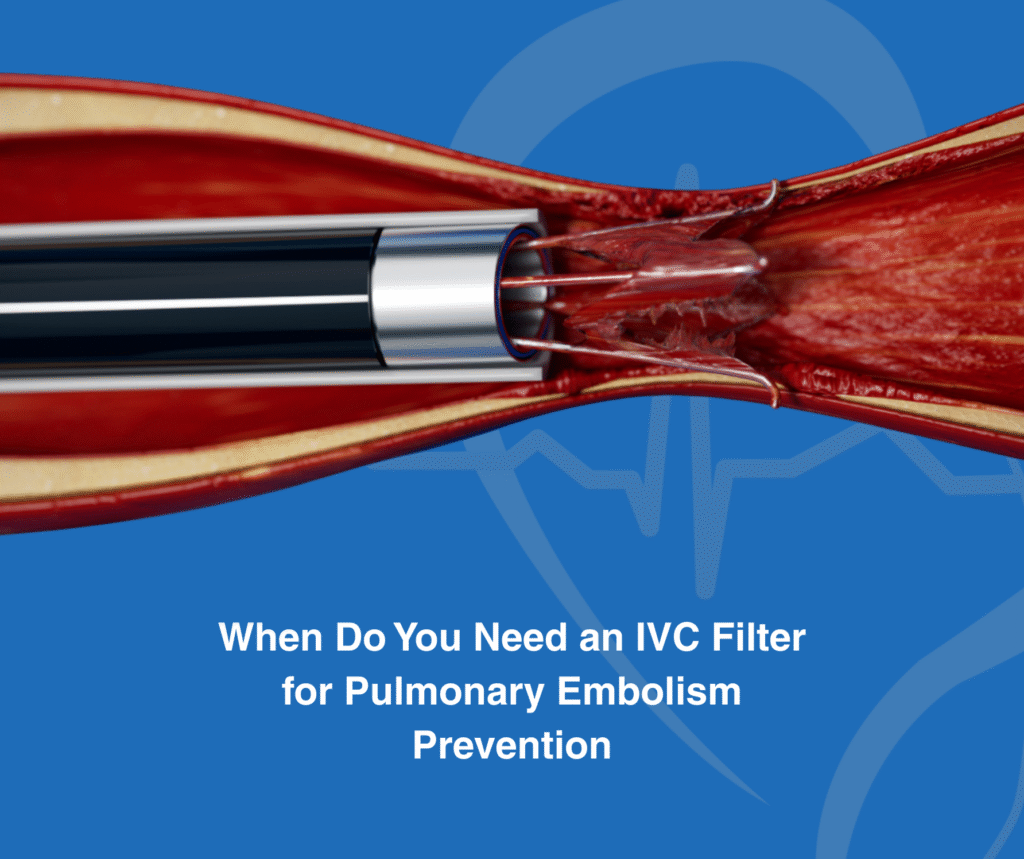
Think about a small umbrella. Now picture that it is a small umbrella or basket that is placed in the biggest vein that travels vertically in the center of the body.
That is the inferior vena cava. The filter is used to capture and hold blood clots that would otherwise make their way to the lungs. Like a catcher’s mitt.
Your doctor can put it in through a small procedure. They’ll go through a vein in your neck or groin, guide the filter into place, and you’re usually done in under an hour.
Most people head home the same day. Blood flows through normally, but any dangerous clots get trapped.
Schedule an appointment, call us at 661-324-4100.
Blood thinners help, but not always. You may have an internal bleed, be planning to have surgery, or your body can’t handle the medication.
One or a combination of these can really complicate things.
You need protection from clots, but the usual fix is off the table.
So what do you do? An IVC filter steps in. It gives you that protection without the bleeding risk that comes with medication.
You may be doing everything right and still, the clots keep forming while taking your prescribed blood thinners. It’s beyond frustrating and can be a little terrifying, too.
Your body’s just not responding to the treatment plan. When that happens, backup is necessary.
IVC filters work independently of all medications so they continue to safeguard you even when the medications stop working.
So it continues to protect you even when the medication isn’t working.
To schedule an appointment, you can call 661-324-4100.
Some situations put you in the danger zone for clots traveling to your lungs. If any of these sound familiar, your doctor might bring up an IVC filter:
When your risk is this high, playing it safe is necessary. Your vascular doctor will look at your specific situation and figure out if the filter makes sense for you.
Not everyone needs a filter forever.
Some are made to come out once you’re past the danger zone. Maybe after you’ve recovered from surgery or an injury.
We call these retrievable filters, and they usually stay in for a few weeks to a few months.
But there are also filters that are permanent. If your condition is not temporary, your doctor may decide that a filter staying in long-term is best.
The doctor will make a decision regarding what type to use depending on your condition and how long they anticipate you will need that extra protection.
Schedule an appointment, call us at 661-324-4100.
If you’ve experienced blood clots in the past, can’t take blood thinner medication, or are having surgery and have a risk of clotting, you need to talk to a vascular specialist – and you need to do it quickly.
Delaying the conversation will not improve the issue.
We understand that vein issues and clot risks are stressful.
This is why procedures that are as minimally invasive as possible are our focus to get you protected and back to your life quickly here at Heart Vascular & Leg Center in Bakersfield.
Call us at 661-324-4100. You deserve answers and a working plan!
How much time will an IVC filter take?
It generally takes around 30-60 minutes. You will receive local anesthesia and be lightly sedated. You will be relaxing and/or napping for most of the procedure.
Are these filters risky?
There are some risks, like with anything medical, the filter could shift or break. Your doctor will go over all of this with you before you decide.
If I have a filter, can I get an MRI?
Most of the new filters have no problems with MRIs, but you should always tell the imaging center that you have a filter so that they can check.
When does a temporary filter come out?
Once your risk goes down and you can go back on blood thinners safely. That’s usually somewhere between 3 and 6 months, but it varies.

Also visit:

