Living with chronic venous insufficiency and varicose veins is challenging.
The pain can be deep aching and there can be bulging, swollen veins, which can create challenges in daily living.
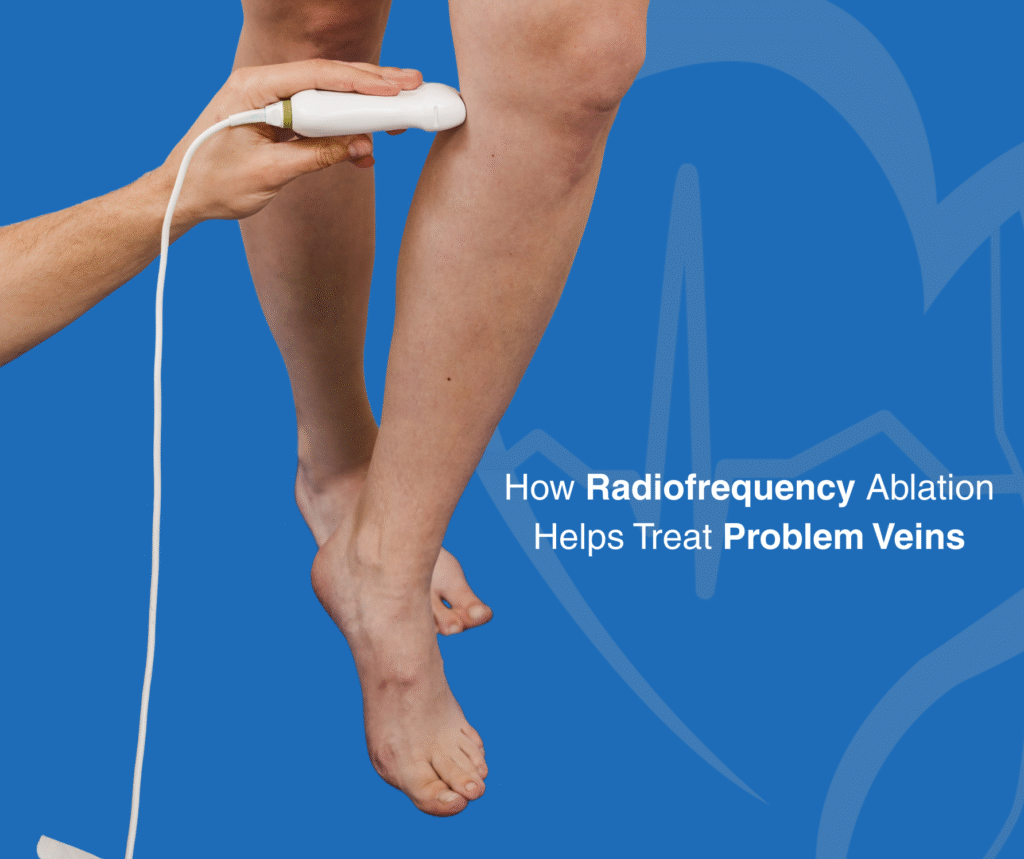
Fortunately, at Heart Vascular and Leg Center, we can offer our patients radiofrequency ablation (RFA).
It’s a cutting-edge minimally invasive procedure. It also provides a faster recovery time than traditional surgical options.
RFA is a minimally invasive procedure. It uses heat to close off problem veins.
Rather than surgically stripping veins out, a thin catheter is inserted into the affected vein, and then controlled radiofrequency energy is delivered.
A controlled amount of energy is delivered to heat the vein wall, which collapses and then seals the wall shut.
Blood is then naturally redirected to the healthier veins that are positioned close by.
One-directional valves are valves that are in your legs and they make sure that blood only flows in one direction.
As soon as the valves of your legs are not functioning, the blood will stagnate in the veins and the veins will wind up twisting and stretching.
In the long run, this can result in the formation of varicose veins and failure to treat it may result in the following issues:
There are a number of other problems caused by untreated vein problems. For further information, schedule your consultation by giving our office a call at 661-324-4100.
This is a very straightforward process.
Your physician will make a small incision and use an ultrasound to direct a catheter to your damaged vein.
Once the catheter gets to the targeted location, a small amount of radiofrequency energy is directed to heat the wall of the vein to approximately 120 degrees Celsius.
This will cause the vein to contract and close.
The entire process takes 45 to 60 minutes. You will be awake the entire time and only be given local anesthesia.
Most patients only feel a slight pressure during the procedure, if they feel anything at all. Once the treatment is complete, the body will absorb the sealed vein over a period of weeks.
You will be able to walk right after the procedure and resume normal activities within a day or two.
It is a huge improvement compared to alternative procedures such as traditional vein stripping. That takes two weeks to recover.
The majority of patients resume working the following day.
Research shows RFA successfully closes the problem vein over 90% of the time. After the closure of the vein, the patient will experience long-term relief of symptoms.
Call us at 661-324-4100 to schedule an appointment!
RFA recovery is smooth for the most part.
After your compression stockings are removed after a week, most people do not find any of the bruising and pain to be a problem and they get through it with an over-the-counter pain medication.
You are allowed to walk right after the treatment to help avoid any blood clots and to help with circulation.
After a week, you are allowed to go back to all of your normal activities, but for that week, you are not allowed to do any heavy lifting or do any exercise that is very strenuous.
RFA is the most effective treatment for patients with chronic venous insufficiency and moderate to severe symptoms.
Your physician is able to assess your symptoms and target the veins needing treatment with an ultrasound.
Good RFA candidates usually have:
If you’d like to start that process, give us a call at 661-324-4100 to set up your appointment.
You should not feel held back by your problem veins any longer! At the Heart Vascular and Leg Center, our team has a lot of experience with radiofrequency ablation.
Let us help you by recommending an approach for your problem veins after assessing your clinical situation.
Call 661-324-4100 or schedule an appointment.
No. Local anesthesia is administered to treat the area and patients might feel a bit of pressure or they may feel a bit of warmth.
RFA provides permanent closure of the treated veins. But varicose veins may develop in other areas, so make sure to monitor and take precautions.
Most insurance providers will cover RFA, which is medically necessary. We’ll be happy to verify insurance and discuss payment options right during your consultation.
The vein you treated won’t be open again, so you won’t get varicose veins in that one, but the risk of getting new ones does exist.
Minimizing that risk will be possible with some of your doctor’s guidelines.

Also visit:

