 |
Diabetes gets a lot of attention for what it does to blood sugar. What gets far less attention is what it does to your blood vessels, specifically the ones in your legs.
Over time, high blood sugar quietly damages artery walls. It narrows them, stiffens them, and reduces the flow of blood to your feet and lower legs. By the time many most diabetic patients notice something is wrong, the problem has often been building for years.
This is called Peripheral Artery Disease, and for people with diabetes it is one of the most important conditions to catch early. You can read a full overview of PAD symptoms and what they mean here, but this blog is specifically about why diabetes makes the risk higher, and why Kern County patients need to pay particular attention.
This is not a general statistic. Kern County has the highest diabetes mortality rate in the entire state of California. More residents here die from diabetes complications than in any other county. That is not a small distinction.
The combination of high diabetes rates, a predominantly sedentary lifestyle, and limited early access to specialist vascular care means that PAD in this region is both more common and more likely to be caught late.
If you have diabetes and live in Bakersfield or the surrounding area, your risk of developing circulation problems in your legs is significantly higher than the national average. And the earlier it is found, the more that can be done about it.
Read Also: PAD Symptoms: What Your Leg Pain Might Be Telling You
Most conditions give you a clear warning. Pain shows up, and you know something is wrong.
Diabetes disrupts that warning system. The same nerve damage that causes numbness and tingling in the feet also dulls the pain signals that would normally tell you your circulation is compromised. This means diabetic patients often feel the symptoms of PAD much later than non-diabetic patients, at a point when the arterial narrowing is already more advanced.
A non-diabetic person might notice leg cramping when they walk and come in for a check. A diabetic patient may not feel that cramping at all, and the first real sign something is wrong is a wound on the foot that simply will not heal.
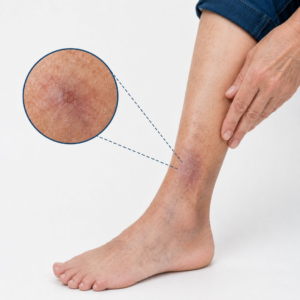 |
A cut or sore on the foot that takes unusually long to heal is one of the most important warning signs of vascular disease in diabetic patients. Most people assume slow healing is just a normal part of having diabetes.
It is not normal. It is a sign that blood flow to that area is compromised. It should not be ignored. In some diabetic patients, a slow-healing wound may indicate impaired circulation, particularly when accompanied by other symptoms of PAD. Without enough blood reaching the tissue, wounds cannot heal properly. Left untreated, this can progress from a slow-healing sore to a serious infection, and in severe cases, to tissue damage that is very difficult to reverse.
Other signs worth paying attention to include skin discoloration on the lower legs, persistent leg swelling, and feet that feel cold even when the rest of the body is warm unusually cold feet or a noticeable temperature difference between one foot and the other . These are all signs the circulation below the knee is not working as it should.
Read Also: Poor Circulation in the Legs: Symptoms and When to See a Specialist
You do not need to be in severe pain to get checked. If you have diabetes and notice any of the following, a vascular evaluation is worth booking:
None of these symptoms on their own are definitive. But in a diabetic patient, any one of them is a reason to get the circulation in your legs properly assessed.
 |
At Heart Vascular & Leg Center in Bakersfield, Dr. Vinod Kumar and his team use non-invasive vascular testing to assess the circulation in your legs. The most common test is called an Ankle-Brachial Index, which compares the blood pressure in your ankle to the blood pressure in your arm. It is simple, painless, and takes only a few minutes.
There is no hospital visit involved. No needles. Most patients are in and out in under an hour. What the test tells you is whether your circulation is healthy, borderline, or compromised, and how urgently further investigation or treatment is needed.
If PAD is identified, the HVLC team offers a full range of minimally invasive treatments to restore healthy blood flow, including angioplasty, atherectomy, and angiogram. All office-based, same-day procedures.
For diabetic patients especially, early detection is not just about managing symptoms. It is about staying ahead of a condition that, if left alone, becomes significantly harder to treat.
Have diabetes and concerned about your leg circulation? Take the free PAD Risk Assessment at heartandleg.com | Or call 661-324-4100 to book a vascular evaluation in Bakersfield |
Why do my legs hurt if I have diabetes?
Diabetes damages the arteries over time, reducing blood flow to the legs. This can cause leg cramping when walking, cold or numb feet, and slow-healing wounds. These are common signs of Peripheral Artery Disease, which is significantly more common in people with diabetes. A vascular evaluation can confirm whether poor circulation is the cause.
Why are diabetics at higher risk for PAD?
High blood sugar damages artery walls over time, causing them to narrow and stiffen. This reduces blood flow to the lower legs and feet. Diabetics are also at higher risk because nerve damage can mask the pain signals that would normally prompt someone to seek medical attention, meaning the condition is often more advanced by the time it is discovered.
Why is my diabetic wound not healing?
Slow-healing wounds in diabetic patients are often a sign of poor circulation. When blood flow to the area is compromised, the tissue does not receive the oxygen and nutrients it needs to repair itself. This is not something to wait on. A vascular check can determine whether reduced circulation is the reason and what can be done about it.
What does a vascular check involve?
At Heart Vascular & Leg Center, a vascular check typically involves a simple, non-invasive test called an Ankle-Brachial Index. It measures blood pressure at the ankle and the arm to assess how well blood is flowing to the legs. It is painless, takes only a few minutes, and does not require a hospital visit.
Where can I get a PAD check for diabetes in Bakersfield?
Heart Vascular & Leg Center, located at 5020 Commerce Drive, Bakersfield, CA, offers vascular testing and PAD treatment for diabetic patients. Dr. Vinod Kumar and his team specialise in diagnosing and treating circulation problems in the legs. Call 661-324-4100 or visit heartandleg.com to book an evaluation.