 |
That ache in your legs when you walk to the car. The one that goes away once you sit down – and comes back the moment you start moving again.
Most people chalk it up to age. Bad shoes. A long day.
Sometimes that’s true. But sometimes, it’s your circulation sending you an early warning – and catching it early is what keeps your options open.
Peripheral Artery Disease (PAD) happens when the arteries that carry blood to your legs get narrowed by a build-up of fatty deposits – a process called atherosclerosis. Your legs stop getting enough blood and oxygen, especially when you’re active and your muscles need it most. You may also notice related symptoms like poor circulation that tend to worsen over time.
It’s not just a leg problem. PAD is a sign of arterial disease that can affect your whole body – including your heart and brain. People with PAD have a significantly higher risk of heart attack and stroke.
Read Also: What Are the Symptoms of PAD? — Full Symptom Guide
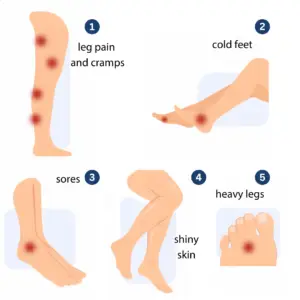 |
PAD often starts quietly. Here are the signs that are easiest to dismiss — and most important not to:
If more than one of these sounds familiar – especially if you have other risk factors – it’s worth getting checked by a vascular specialist.
Read Also: Can DVT Go Away on Its Own? — Related Vascular Conditions Explained
PAD is more common than most people realise – affecting around 12 million + Americans. You’re at higher risk if you:
Even if you feel fine today, a simple vascular screening can tell you exactly where things stand. Early detection is what keeps your treatment options minimally invasive.
Read Also: Take the Free PAD Risk Assessment — heartandleg.com
PAD often develops quietly. By the time the pain is hard to ignore, the condition may already be quite advanced.
In the early stages, treatment is usually straightforward – often a minimally invasive, same-day procedure with no hospital stay needed. As PAD progresses, complications become more serious: wounds that won’t heal, tissue damage, and in severe untreated cases, the risk of limb complications.
Conditions like restless legs, leg swelling, and skin discoloration are often early signals that vascular health is already being affected. Catching these before they worsen is what changes the outcome.
Read Also: Why Minimally Invasive Vascular Care Is Central to Our Mission
 |
At Heart Vascular & Leg Center in Bakersfield, Dr. Vinod Kumar — an Interventional Cardiologist trained at UCLA and Baylor — leads a specialist team that diagnoses and treats PAD using advanced, minimally invasive techniques. Learn more about our full range of vascular treatments including angioplasty, atherectomy, and angiogram.
No hospital. No lengthy recovery. Many patients are seen and treated the same day.
The goal is simple: restore healthy blood flow before the condition gets harder to treat.
Read Also: Meet Our Vascular Specialists — Dr. Vinod Kumar & Team
What does PAD feel like in the legs?
PAD most commonly feels like an aching, cramping, or heavy sensation in the legs that comes on during walking or activity and goes away within a few minutes of rest. This is called claudication. In more advanced cases, the pain can be present even at rest – particularly in the feet and toes. Some people also notice their feet feel unusually cold, or that leg fatigue sets in much faster than it used to.
Can leg pain when walking always be a sign of PAD?
Not always – leg pain while walking can also come from nerve compression, muscle strain, or joint issues. The key difference with PAD is that the pain is triggered by activity and relieves quickly with rest. If you’re experiencing this pattern consistently, especially alongside other risk factors like diabetes or smoking, it’s worth getting a vascular evaluation. A simple, non-invasive test called an Ankle-Brachial Index (ABI) can confirm whether PAD is present.
Is PAD dangerous if left untreated?
Yes. PAD can often be managed with lifestyle changes and medications, especially in the early stages, but it usually does not reverse on its own.
If left untreated, PAD can progress and may lead to non-healing wounds, infections, limb complications, and a higher risk of heart attack or stroke. Early vascular evaluation is important.
How is PAD diagnosed?
PAD is usually diagnosed using a non-invasive test called an Ankle-Brachial Index (ABI), which compares blood pressure in the ankle to blood pressure in the arm. An imaging test called a vascular ultrasound may also be used to see exactly where blockages are occurring. At Heart Vascular & Leg Center, all diagnostic testing is done in-office – no hospital visit required.
Can PAD be treated without surgery?
In many cases, yes. HVLC specialises in minimally invasive treatments for PAD — including angioplasty and atherectomy – that are performed as same-day office procedures. These techniques open narrowed arteries and restore blood flow without the need for traditional open surgery. The right treatment depends on the severity and location of the blockage, which is why a proper diagnosis is the first step.
Book a knee pain consultation at heartandleg.com Call 661-324-4100 | Available in Bakersfield, CA | Same-day appointments may be available |